
 World Braille Day – January 4th
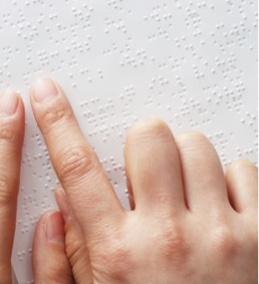 World Braille Day – January 4th
What comes to mind when you hear the world “braille”? Do you think of bumps? Do you think of people who are blind? Or do you think of something that you can’t understand? If you are someone who can’t access braille, think about how those who are blind can’t access the printed word. How does that make you feel?
The percentage of those who are blind is a matter of statistics. Those with severe vision loss or “blindness” are combined with those with “low vision” or vision impairment that can’t be fully corrected. This combining of definitions often leads to different percentages.
The percentage of blindness in adults aged 40+ who are legally blind in the United States is around 0.7% to 1%.
Approximately 6.8% of children under 18 in the U.S. have a diagnosed eye and vision condition and nearly 3% of children under 18 years have blindness or vision impairment. This is defined as having trouble seeing even when wearing glasses or contact lenses.
Approximately 7 million people in the U.S. have vision impairment – 1 million of these are blind. This means 1 million people in the U.S. would benefit having access to braille when reading books and navigating their environment. According to the CDC, vision disability is one of the top 10 disabilities among adults 18 years and older and it is one of the most prevalent disabling conditions among children.
January 4th marks World Braille Day in celebration of its creator, Louis Braille. He was born in Coupvray, France on January 4th, 1809. He was blinded in an accident when he was three years old. Louis Braille entered the Royal Institute for Blind Youth in Paris in 1819. While in school, he learned of a system of tangible writing using dots, invented several years earlier by Charles Barbier. It was called night writing and was long thought to have been intended for nighttime battlefield communications that involved a raised 12-dot system.
In 1824, when Braille was only 15 years old, he developed a six-dot “cell” system. He used Barbier’s system as a starting point and cut its 12-dot configuration in half making the system less confusing. The system was first published in 1829 with a more complete elaboration in 1837.
A universal Braille code for the English-speaking world was adopted in1932 when representatives from agencies for the blind in Great Britain and the United States met in London and agreed upon a system known as Standard English Braille. This consists of around 250 letters (phonograms), numerals, punctuation, formatting marks, contractions, and abbreviations (logograms). Some English Braille letters, such as ⠿ ⟨for⟩, correspond to more than one letter in print.
Every day, thousands of blind people use Braille for everything from shopping lists to labels for canned goods, from reading novels to solving math and scientific equations, from learning a piece of music to composing one. The increasing availability of Braille signs makes it easier for blind people to get around hotels, office buildings, government facilities, university campuses, and more. Braille is as flexible as print, can be learned in roughly the same amount of time, and can be read just as fluidly.
Lilac Services for the Blind is available to provide people in North Central and Eastern Washington who are blind or have low vision with the training and adaptive devices needed to restore, maintain, or increase their independence and quality of life. They have an office in Spokane and in Wenatchee.
 DAC NEW
222 W Mission Ave Suite 230
Spokane, WA 99201
509-606-4639
Colville: 509-338-8738